
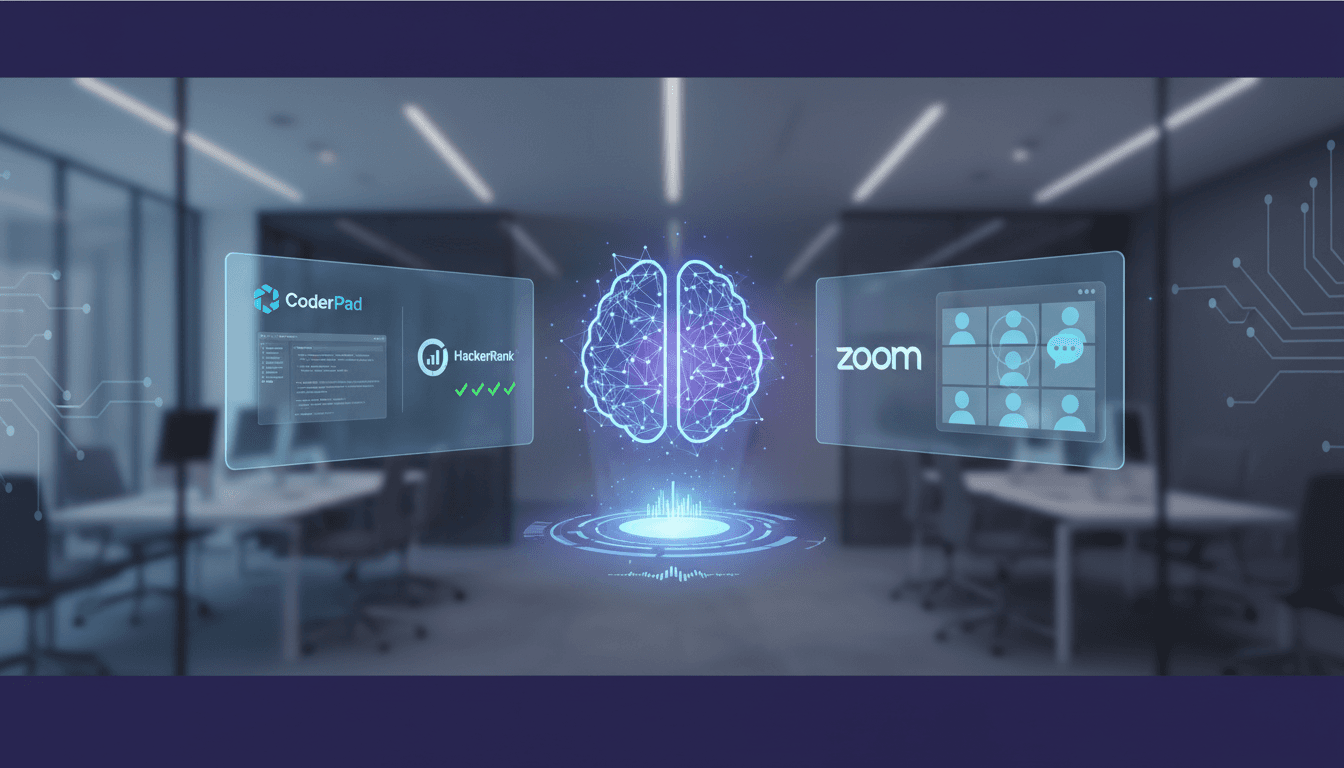
That HackerRank challenge, the one where you're struggling to get past the third test case, or the CoderPad screen flickering with a blank page—yeah, I've been there. We've all been there. And then the Zoom link pops, and you're staring at your own reflection, trying to remember if you can still reverse a linked list in under 5 minutes. The whole interview process, especially for top-tier tech, feels designed to trip you up. But what if you had a silent interview assistant, a kind of digital wingman, to help you navigate these minefields?
I'm not talking about cheating, not even close. We're talking about smart, ethical preparation using AI-driven tools that actually reflect the real-world interview environment. Think of it as a highly personalized, infinitely patient coach who spots your weaknesses before the actual interview. This isn't theoretical; this is what smart engineers are already doing.
Your Brain on AI: Beyond LeetCode Grinding
Let's be blunt: raw LeetCode grinding without strategy is like doing bicep curls all day and expecting to win a marathon. You need targeted practice. An AI interview assistant doesn't just present problems; it actively analyzes your performance. When you're tackling a problem on CoderPad or a similar platform, these tools aren't just checking correctness. They're looking at your thought process.
Consider an AI that listens to your verbalized thought process during a mock interview. It can flag if you're jumping to code too quickly, if you're not clarifying edge cases, or if your time complexity analysis is consistently off. That's invaluable feedback. A human interviewer might give you vague "think out loud more" advice. An AI can pinpoint exactly where you stopped thinking out loud or where your logic diverged from an optimal path. It’s like having a senior engineer pair programming with you, but one who has perfect recall and no ego.
The CoderPad & HackerRank Advantage: Real-Time Feedback
Imagine you're solving a medium-difficulty problem on a mock CoderPad. You write some code, hit run, and it fails. What do you do next? A common mistake is to just stare at the screen, or worse, frantically change random lines. An AI assistant, integrated with your coding environment, can offer subtle nudges. It won't give you the answer. It might suggest, "Consider the constraints on N," or "Have you accounted for empty inputs?"
For HackerRank-style challenges, where often the exact problem statement is a thinly veiled variation of a classic algorithm, an AI can identify patterns in your failed attempts. If you consistently struggle with dynamic programming problems that involve state compression, it's going to notice. Then it can recommend specific problem types or even tutorial sections to shore up that exact weakness. This is far more efficient than aimlessly scrolling through LeetCode's "Top Interview Questions" list.
The key here is real-time. A human coach can't sit there for an hour watching you debug. An AI can, and it learns from every keystroke, every compilation error, every successful test run. This personalized data builds a profile of your coding strengths and, more importantly, your specific blind spots. It's not about brute force, but surgical improvement.
Mastering the Zoom Interview: Behavioral & System Design
Technical interviews aren't just about coding. The Zoom portion—behavioral and system design—often makes or breaks your candidacy. This is where AI tools really shine beyond just algorithms.
For behavioral questions, an AI can simulate an interviewer, asking questions like "Tell me about a time you failed" or "How do you handle conflict?" You record your answers. The AI then analyzes aspects like:
- Pacing and Fluency: Are you speaking too fast or too slow? Are there excessive filler words ("um," "uh")?
- STAR Method Adherence: Did you clearly articulate the Situation, Task, Action, and Result for experience-based questions? Many candidates flub this.
- Keyword Analysis: Does your answer include relevant terms for the role and company values?
- Confidence Indicators: This gets tricky, but some advanced tools can look for vocal patterns or even subtle facial cues (if you opt-in for camera analysis, which I'd recommend for practice).
For system design, AI can simulate a more interactive dialogue. You present your solution for, say, "Design Twitter's News Feed." Instead of just getting a generic "good job," the AI can ask follow-up questions a real interviewer would: "How would you handle hot-sharding for celebrity accounts?" or "What's your strategy for graceful degradation during a database outage?" It can even challenge your assumptions, pushing you to defend your choices—a critical skill in a real interview. This forces you to think on your feet, just like you would with a senior engineer grilling you.
Specific Tools and How to Use Them (Ethically)
Okay, so what does this look like in practice? Several platforms are integrating AI for interview prep. Pramp offers peer-to-peer mocks, but some features now include AI feedback. Interviewing.io has an AI coach that gives you immediate feedback on your responses. For coding, platforms like AlgoExpert are exploring AI-powered hints and detailed performance analysis.
Here's how you should use them:
- Warm-up: Start with a few classic problems. Don't go straight for the hardest ones.
- Verbalize Everything: Treat the AI as a human. Talk through your thought process, your assumptions, your edge cases. This is crucial for system design and behavioral, but equally important for coding.
- Review the AI Feedback Religiously: Don't just dismiss it. If it says you're not clarifying constraints, make a conscious effort to do that in the next problem.
- Target Weaknesses: If the AI consistently flags your understanding of graph algorithms, spend a dedicated session just on those. Don't just keep doing array problems because they feel comfortable.
- Simulate Real Conditions: Set a timer. Don't pause mid-interview. Try to replicate the pressure.
Now, a caveat: no AI can perfectly replicate the nuances of a human interviewer. A real person might pick up on your subtle humor, your passion for a specific technology, or your overall cultural fit in a way an AI never will. So, while these tools are fantastic for honing your technical and communication skills, don't let them replace actual human interaction where possible. Do a few mock interviews with colleagues or friends. The AI perfects your mechanics; a human helps you polish your presence.
Beyond the Interview: A Skill for Life
The skills you hone using an AI interview assistant—structured problem-solving, clear communication, robust error handling, and efficient debugging—aren't just for getting a job. These are the very tenets of being a successful senior engineer. Thinking out loud, articulating a system design, or debugging methodically are daily occurrences, not just interview acrobatics.
You're not just practicing for a specific interview. You're building a mental framework for tackling complex technical challenges. This isn't just about acing CoderPad; it's about becoming a better, more efficient problem solver, a skill that will serve you throughout your career. Invest in these tools, use them smartly, and you'll find yourself not just passing interviews, but excelling in your daily work, too.
Ready to Ace Your Next Interview?
Practice with AI-powered mock interviews tailored to your target role and company. Start Practicing for Free | Explore Interview Prep