
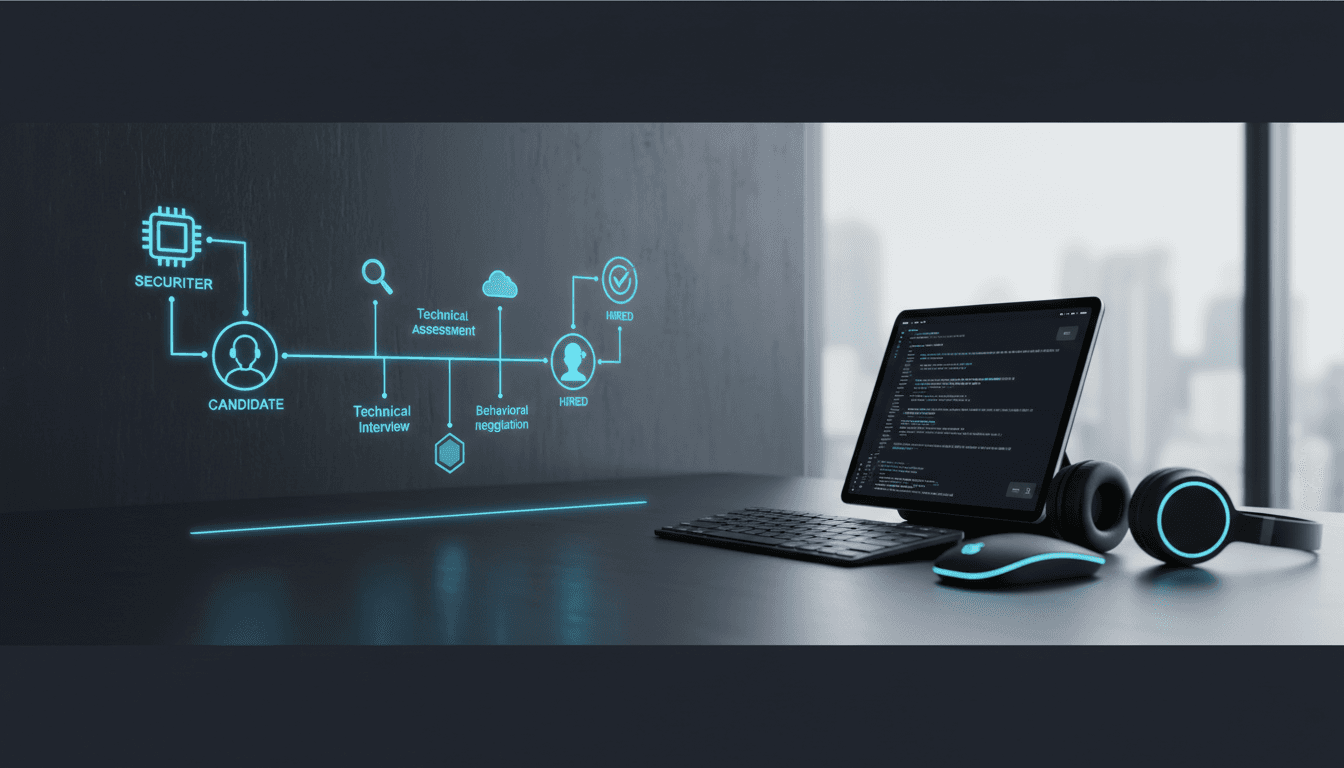
Beat Recruiter Hurdles: Your Interview Playbook
That inbox notification. We've all seen it. "Congratulations! Your profile matches what we're looking for." Or, more accurately, "We skimmed your LinkedIn and your job title sounds right." You're not through the door yet; in tech, interviews often feel like an Olympic qualifying round just to talk to someone technical. Beating the initial recruiter hurdle is less about being the 'perfect' candidate and more about understanding the game and playing it strategically. I've sat through enough FAANG loops, bombed my share of interviews, and learned what actually works—not just what sounds good on a LinkedIn post.
The Recruiter's Game: Understand Their Incentives
Recruiters aren't evil gatekeepers, they're often overworked matchmakers with KPIs. Their goal is to fill roles quickly with candidates who look good on paper and sound good on the phone, minimizing actual technical vetting on their end. Think of them as an early warning system for obvious mismatches. They scan for keywords, tenure, company names, and a general vibe. Your job is to give them exactly what they need to tick their boxes and pass you along. Don't assume they understand the nuance of your 10x developer status; they're looking for signals.
Most often, the recruiter call is a quick 15-30 minute chat. They'll ask about your experience, what you're looking for, salary expectations, and why you're interested in this specific role. This isn't a technical interview, but it's where you sell your narrative. Have your 30-second elevator pitch ready: "I'm a senior backend engineer with 8 years building scalable microservices in Python and Go, specifically looking for opportunities to lead projects in distributed systems at a company focused on X." That's direct, specific, and gives them keywords to punch into their system.
Don't ever, ever go into this call without having read the job description thoroughly. Highlight 3-5 key skills or experiences they're looking for, and be ready to articulate how you meet each one. For example, if they list "experience with Kubernetes," don't just say "I've used Kubernetes." Instead, "I led the migration of our legacy monolith to a Kubernetes cluster, reducing deployment times by 40% and improving reliability through [specific tool like Prometheus] monitoring." Quantify where you can. Remember, they're not interviewing you for your deep technical knowledge, they're checking if you fit the superficial criteria and can hold a conversation.
Crafting Your Digital Footprint: Resumes and LinkedIn that Convert
Your resume and LinkedIn profile are your primary weapons against the recruiter filter. These aren't just historical documents; they're marketing collateral. You need to optimize them for their search, not just for your ego. Keywords are paramount. Look at 5-10 job descriptions for roles you actually want. What technologies, methodologies, and soft skills appear repeatedly? Those are your targets. Weave them naturally into your experience descriptions, not just a keyword dump at the bottom.
For your resume, stick to a clean, readable format. One page for under 10 years of experience, two pages maximum beyond that. Use strong action verbs. Instead of "Responsible for managing a team," try "Led a team of 5 engineers delivering high-performance APIs." Every bullet point should quantify impact where possible. "Improved latency by 20%" is always better than "Optimized database queries." Use numbers: "Managed a budget of $500K," "Scaled a system to handle 1M daily users." These concrete details give recruiters something tangible to latch onto.
Your LinkedIn profile should mirror your resume but offer more depth. Use the "About" section as a narrative pitch for who you are and what you bring. Don't just list previous roles; explain the impact you made. Connect with people in your target companies. Engage with relevant posts. Recruiters absolutely stalk LinkedIn, and a dormant profile with minimal connections raises eyebrows. Make it easy for them to find and validate you. An often-overlooked secret: update your "Open to work" preferences privately on LinkedIn. Recruiters use these filters.
The Phone Screen: More Than Just a Vibe Check
After the initial recruiter chat, you’ll usually get a technical phone screen. This is typically 30-60 minutes with an actual engineer. This isn’t a deep dive into algorithms or system design, but it’s far more technical than the recruiter call. They're checking for fundamental competency and communication skills. They want to know if you can talk intelligently about code, your past projects, and basic data structures.
Expect questions about your most recent projects. "Walk me through a challenging problem you solved." "Describe a time you disagreed with a technical decision and how you handled it." Be ready to discuss the trade-offs you made, the technologies you used, and the why behind your choices. They're probing for your engineering thought process, not just facts. Practice articulating your solutions clearly and concisely. You don't need to write code on a whiteboard, but you might need to pseudo-code or explain an algorithm verbally.
They might ask a simple coding question—something like reversing a string, finding duplicates in an array, or basic tree traversal. The goal isn't necessarily to write perfect, bug-free code right then, but to show your thought process. Talk through your approach, discuss edge cases, and explain your choice of data structures. Always clarify constraints: "Can the array contain nulls?" "Is it sorted?" Don't just jump into coding. This demonstrates strong communication, which is a massive plus.
Whiteboard or Shared Doc: Cracking the Coding Challenge
This is where many engineers stumble, myself included, especially if you're out of practice. The coding challenge can take many forms: a shared online document, a dedicated coding platform like HackerRank, or even a literal whiteboard. Regardless of the medium, the objective is the same: demonstrate your problem-solving process, coding proficiency, and ability to communicate under pressure. This stage is often called the "technical screen" or "coding interview."
Preparation is non-negotiable. Spend daily time on LeetCode, HackerRank, or similar platforms. Focus on the "easy" and "medium" problems first. Don't just memorize solutions; understand the underlying algorithms and data structures. Practice explaining your thought process out loud. Start with a brute-force solution, then optimize it. Talk about time and space complexity (Big O notation). "My current solution is O(N^2) because of the nested loop, but I think we can get it down to O(N log N) using a hash map and sorting." This shows critical thinking.
When you get a problem, don't immediately start coding. First, ask clarifying questions. "Are there any constraints on input size?" "What kind of data will be passed?" "Are there duplicates?" "What should happen if the input is empty or null?" Then, outline your approach verbally. "My initial thought is to use a hash map to store frequencies..." Get agreement from the interviewer before you write a single line of code. Write pseudo-code first if it helps you organize your thoughts.
As you code, narrate your process. "I'm using a for loop here because I need to iterate over all elements... I'm adding x to the hash map now..." If you hit a snag, vocalize it: "Hmm, this edge case for negative numbers isn't being handled. I think I need to add a conditional check here." This transparency is crucial. Interviewers value your ability to debug and iterate more than a perfect first attempt. Finally, after coding, walk through your solution with a sample input, tracing variables. Test for edge cases. This shows thoroughness.
System Design: Architecting Your Way Through
The system design interview is often the most intimidating, especially for senior roles. You won't be writing code, but you'll be drawing boxes and arrows on a whiteboard or a virtual canvas. They're testing your ability to think at scale, make trade-offs, and design resilient, performant systems. This isn't about memorizing every AWS service; it's about applying fundamental distributed systems principles.
Start with requirements clarification. What's the goal of the system? What are the functional and non-functional requirements? "How many users will this system support daily/monthly?" "What's the expected latency?" "What's the data consistency model?" "Are there specific security or compliance needs?" Don't just assume; ask. This shows you think about the product and business context, not just the tech.
Then, break down the problem. Start with the highest-level components: clients, API gateway, core services, database. Discuss each component's role and how it interacts with others. For example, if you're designing a URL shortener, you might start with: "We'll need a service to generate short URLs, another to handle redirection, and a database to store the mappings."
Dive into specific components and technologies. For the database, discuss choices: "For our URL shortener, a NoSQL database like Cassandra or DynamoDB would be good for its high write throughput and scalability, given we're primarily storing key-value pairs. But if we need stronger consistency and complex queries, a relational database might be better, perhaps sharded." Justify your choices. Explain the pros and cons of alternatives.
Consider common system design patterns: caching (Redis, Memcached), load balancing (Nginx, AWS ALB), message queues (Kafka, RabbitMQ), asynchronous processing, data sharding, replication, fault tolerance, monitoring. Don't try to cram everything in. Focus on a few key areas that are most relevant to the problem and discuss them in depth. A good system design interview is a collaborative discussion, not a lecture. Be open to feedback and suggestions.
Behavioral Questions: Show, Don't Just Tell
Behavioral interviews—often with a hiring manager or senior leader—are your chance to showcase your soft skills, leadership potential, and cultural fit. They generally follow the STAR method: Situation, Task, Action, Result. Don't just tell them you're a great communicator; show them with an example.
Common questions include: "Tell me about a time you failed." "Describe a conflict with a teammate and how you resolved it." "What's the biggest technical challenge you've faced?" "How do you handle tight deadlines?" Prepare 5-7 solid STAR stories that highlight different facets of your experience: leadership, conflict resolution, technical challenges, failures, successes, learning experiences.
For each story, clearly articulate the Situation (context of the problem), the Task (your specific responsibility), the Action you took (what you did, not what the team did), and the Result (quantifiable impact, what you learned, how you grew). For instance, don't say, "We fixed a critical bug." Say, "A critical bug in our payment processing system caused a 5% revenue loss daily. My task was to identify and resolve the root cause within 24 hours. I immediately rolled back the last deployment, then methodically debugged logs, pinpointing a race condition in the process_transaction function. I then implemented a mutex lock, deployed the fix, and verified its efficacy through real-time monitoring. We restored full functionality within 18 hours, preventing further revenue loss and ensuring customer trust." Specifics make your answer compelling.
Be honest and authentic. Don't try to invent stories. Interviewers can spot fakes a mile away. It's OK to admit mistakes and talk about what you learned. In fact, it often makes you a stronger candidate. Everyone makes mistakes; great engineers learn from them.
The Post-Interview Debrief: Learn and Iterate
You finished the gauntlet. Now what? The process doesn't end when you hang up. Take notes immediately after each interview. What questions were asked? What did you do well? Where did you struggle? What could you have done better? This isn't just for this job; it's for the next one. Interviewing is a skill, and like any skill, it improves with practice and reflection.
Send a brief, personalized thank-you note to each interviewer within 24 hours. Reiterate your interest, mention something specific you discussed, and thank them for their time. This little gesture can make a difference. It shows professionalism and enthusiasm.
If you don't get the offer, ask for feedback. Some companies will provide it, some won't. If they do, take it constructively. Don't get defensive. Use it to improve for your next opportunity. Maybe your system design was too generic, or your coding solution missed edge cases. This feedback is gold.
Ultimately, tech interviews are a performance. You're demonstrating your skills, thought process, and personality under pressure. Some days you'll nail it, some days you won't. It's a numbers game, and sometimes, despite your best efforts, you just don't click with the interviewer, or the role shifts, or a different candidate with a niche skill pops up. That’s okay. Keep practicing, keep learning, and keep iterating. Your next opportunity is always around the corner.
Ready to Ace Your Next Interview?
Practice with AI-powered mock interviews tailored to your target role and company. Start Practicing for Free | Explore Interview Prep