
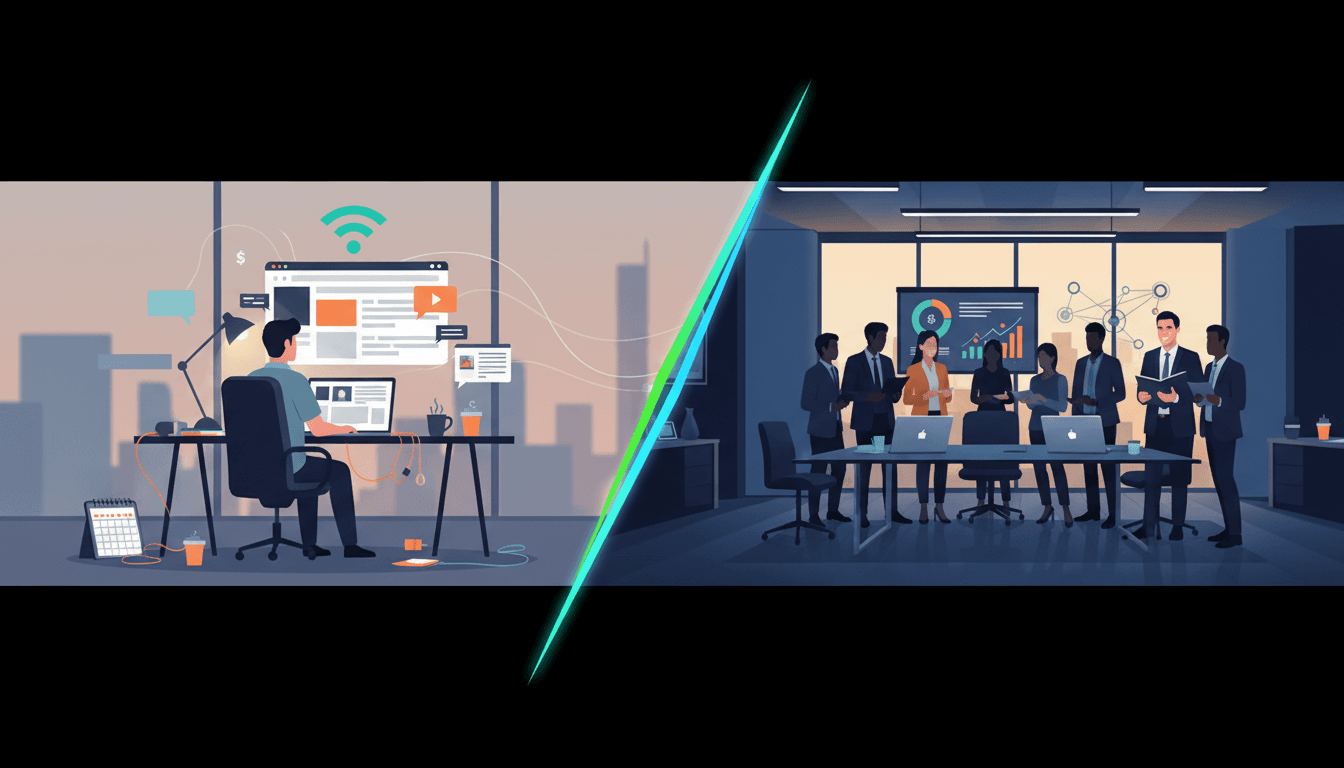
From Freelance Hustle to Full-Time Grind: When to Jump
You've just wrapped up a two-month contract refactoring a legacy Node.js API, the client's thrilled, and your bank account's looking healthy. The freedom of freelance tech work is intoxicating – pick your projects, set your hours, no soul-crushing stand-ups. But then you scroll LinkedIn, see a friend just got promoted to Senior Staff at Google, and a tiny voice whispers, "Am I missing out?" That's the pivot point, friend. That's when you start wondering if it’s time to make the leap from freelance to full-time.
I’ve been there. I’ve seen the allure of both sides. This isn’t a guide to picking one over the other permanently; it’s about recognizing the right moment to shift gears when full-time tech becomes the smarter play for your career.
Why Even Consider Leaving the Freelance Dream?
Let's be frank: freelancing offers unparalleled autonomy. You control your stack, your schedule, your clients. You become a mini-CEO, handling sales, project management, and execution. It's a fantastic way to rapidly prototype your skills, learn new technologies on demand, and build a diverse portfolio. You can easily out-earn many full-time roles, especially if you’ve niched down into something like high-demand Rust performance optimization or intricate Kubernetes cluster management.
But there are invisible ceilings. Compensation plateaus; clients often aren't looking for someone to architect their next generation of products, they want tasks done. You hit a wall when you crave deeper impact, sustained contribution to a single product, or the kind of complex, multi-year engineering challenges that only scaled organizations can provide. Think about contributing to a core AWS service – that’s not a freelance gig. You also miss out on the dedicated R&D budgets, internal training programs, and mentorship opportunities that a well-structured full-time role provides. Your network might be broad, but often it lacks the depth of internal relationships that truly accelerate career growth.
The Interview Prep: It's Not Your Typical Client Pitch
Shifting from freelance to full-time, especially at a FAANG or a rapidly growing startup, means dusting off a completely different skillset. You’re not selling a solution to a client problem; you're demonstrating your engineering chops under pressure. This isn’t about showing off a polished portfolio – though that helps – it's about algorithmic thinking, system design, and behavioral alignment.
Your average freelance project might involve building a CRUD app with Next.js and Prisma, deploying to Vercel. Impressive, sure. But Google wants to know if you can invert a binary tree in 30 minutes, or design a distributed cache system from scratch, complete with consistent hashing and eviction policies. You’ll need to dedicate serious time – I'm talking 3-6 months, 10-15 hours a week – to LeetCode, Grokking the System Design Interview, and practicing behavioral answers. Don't skip the behavioral stuff; it’s where many strong engineers trip up because they haven't articulated their impact and conflict resolution strategies concisely.
When Your Growth Plateaus: The Technical Hunger
This is a big one. You've been freelancing for three, four, five years. You're good, really good, at what you do. But are you learning new things, or just applying the same patterns to different clients? If your last three projects all looked variations of "build a React frontend for a REST API," you might be in a rut. You’re not getting exposed to the cutting-edge of distributed systems, machine learning pipelines, or large-scale infrastructure challenges that companies like Meta or Netflix grapple with daily.
Full-time roles at these companies offer a firehose of new technical challenges. You'll work with engineers who are specialists in areas you've only skimmed. You'll see how massive codebases are managed, how production incidents are handled at scale, and how product roadmaps translate into complex engineering tasks spanning multiple teams. That kind of exposure is invaluable. It broadens your perspective, deepens your understanding of engineering trade-offs, and frankly, makes you a much more valuable technologist. You're moving from being a general practitioner to a specialist within a larger, more complex organism.
The "What If I Bomb?" Mentality: Overcoming Fear of Failure
Everyone, and I mean everyone, bombs interviews. I've been coding for 15 years, and I still get stumped. My first FAANG loop was a disaster. I thought I was hot stuff after a few successful freelance projects, then got hit with a graph traversal problem I hadn't seen in years. My system design was a rambling mess. It felt awful.
The crucial takeaway isn't that you're bad; it's that interview skills are distinct from coding skills. You will fail some. It’s a numbers game. Treat each interview like a practice run with live feedback. Refine your approach. Learn from your mistakes. Don’t let the fear of bombing prevent you from trying. Think of it as a low-stakes investment in your future. Even if you don't get the offer, you've improved your problem-solving and communication skills, which are transferable.
The Financial Calculation: Beyond the Hourly Rate
Let's talk money, but not just the obvious stuff. On paper, freelancing at $150/hour looks great. Do 40 hours a week, and that's $6,000. $300k a year. But how many weeks are you actually working? Factor in unpaid holidays, sick days, client acquisition, invoicing, and professional development. Suddenly, that $300k might be closer to $200k or even $180k.
Now consider the full-time offer: a $200k base salary, plus $50k in RSUs vesting over four years, a 15% bonus target, top-tier health insurance, 401k match, free food, gym stipends, relocation packages. That's a total compensation package easily hitting $300k+ in year one, with significantly less financial volatility. Plus, there's the implicit value of career progression. A Senior Staff Engineer at a top company can easily clear $500k-$1M+ in total compensation. That trajectory is much harder to replicate as a freelancer, where your income often scales linearly with your time. You're trading some short-term flexibility for long-term financial security and explosive growth potential. This is especially true if you're looking to buy a house, start a family, or build long-term wealth – the stability and benefits of full-time often win out.
Your Personal "Why": Impact, Learning, and Stability
Ultimately, the decision to jump from freelance to full-time tech is deeply personal. Are you feeling isolated? Do you crave the camaraderie of a team working towards a shared vision? Do you want to build something that millions of people use, knowing your code is part of a massive, critical infrastructure? Or maybe you just want to stop worrying about where the next contract is coming from.
For me, the shift came when I realized I wanted to build complex systems, not just components. I wanted to see my work evolve over years, not months. I craved the intellectual sparring with brilliant colleagues and the structure that larger organizations provide. Freelancing is fantastic for a season, but for me, the long game was in full-time contribution. There's no right or wrong answer here. Just your answer.
Ready to Ace Your Next Interview?
Practice with AI-powered mock interviews tailored to your target role and company. Start Practicing for Free | Explore Interview Prep